Legacy. Noun. “A situation that has developed as a result of past actions and decisions.” — Cambridge Dictionary
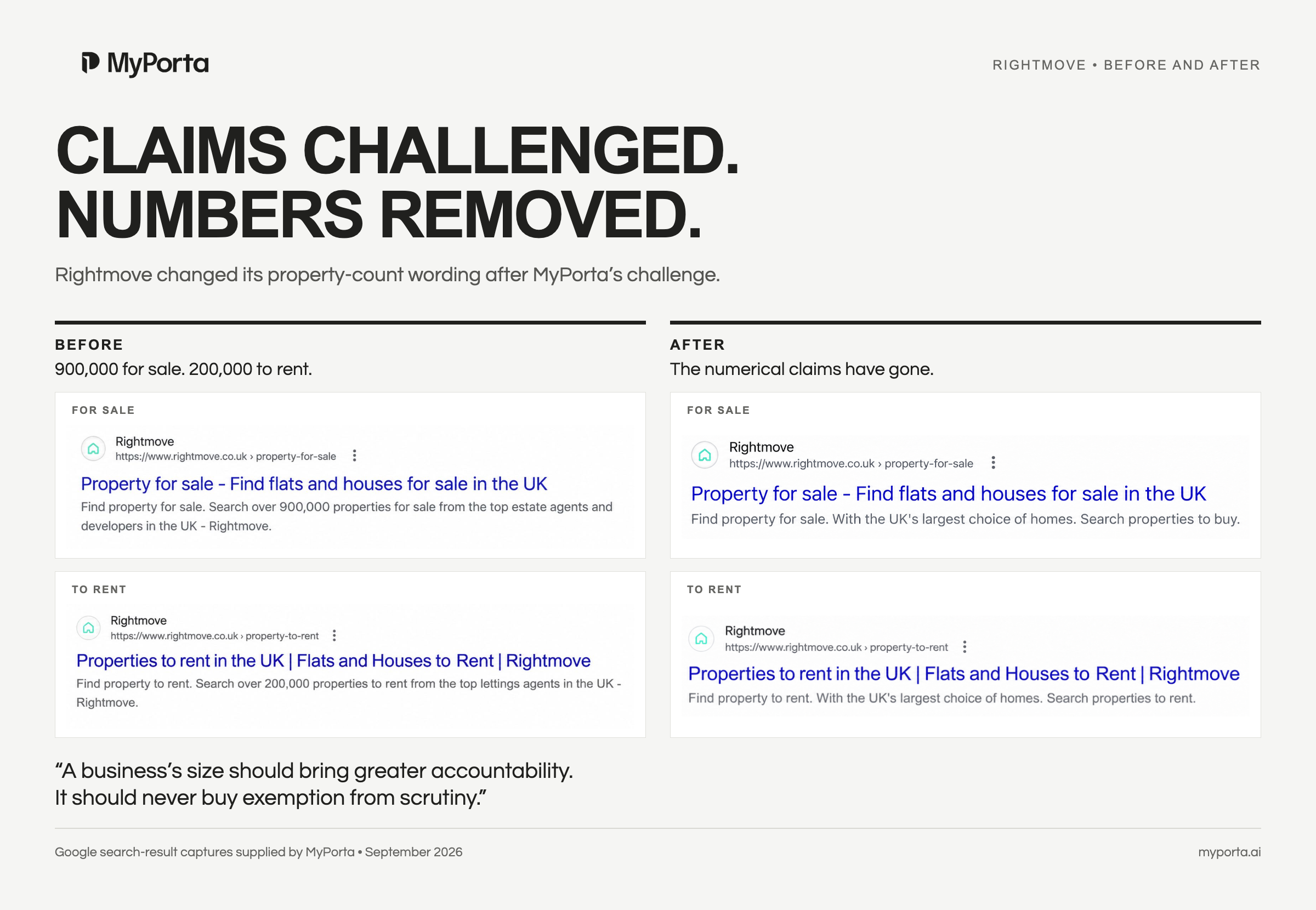
Last month, September 2026, Rightmove claimed they had “over 900,000 properties for sale” and “over 200,000 properties to rent” - an extraordinary amount.
Also completely untrue.
No consumer is going to check - they're just going to think, with such a huge number, they don't need to bother searching elsewhere.
But MyPorta did check. We know that there are not 1.1m properties on the market because we list or link to all the discoverable ones. There's about 850k in total. And we confirmed that Rightmove only has 680k of those - around 40% less than it claimed last month.
We gave them a week to back up their claim to '1.1m properties' before we went to the Advertising Standards Authority. Rightmove took the claim down at the very last moment they could - because they had to. You aren't allowed to claim things that aren't true as a business - people make bad decisions that benefit you and deprive your competitors of deserved results.
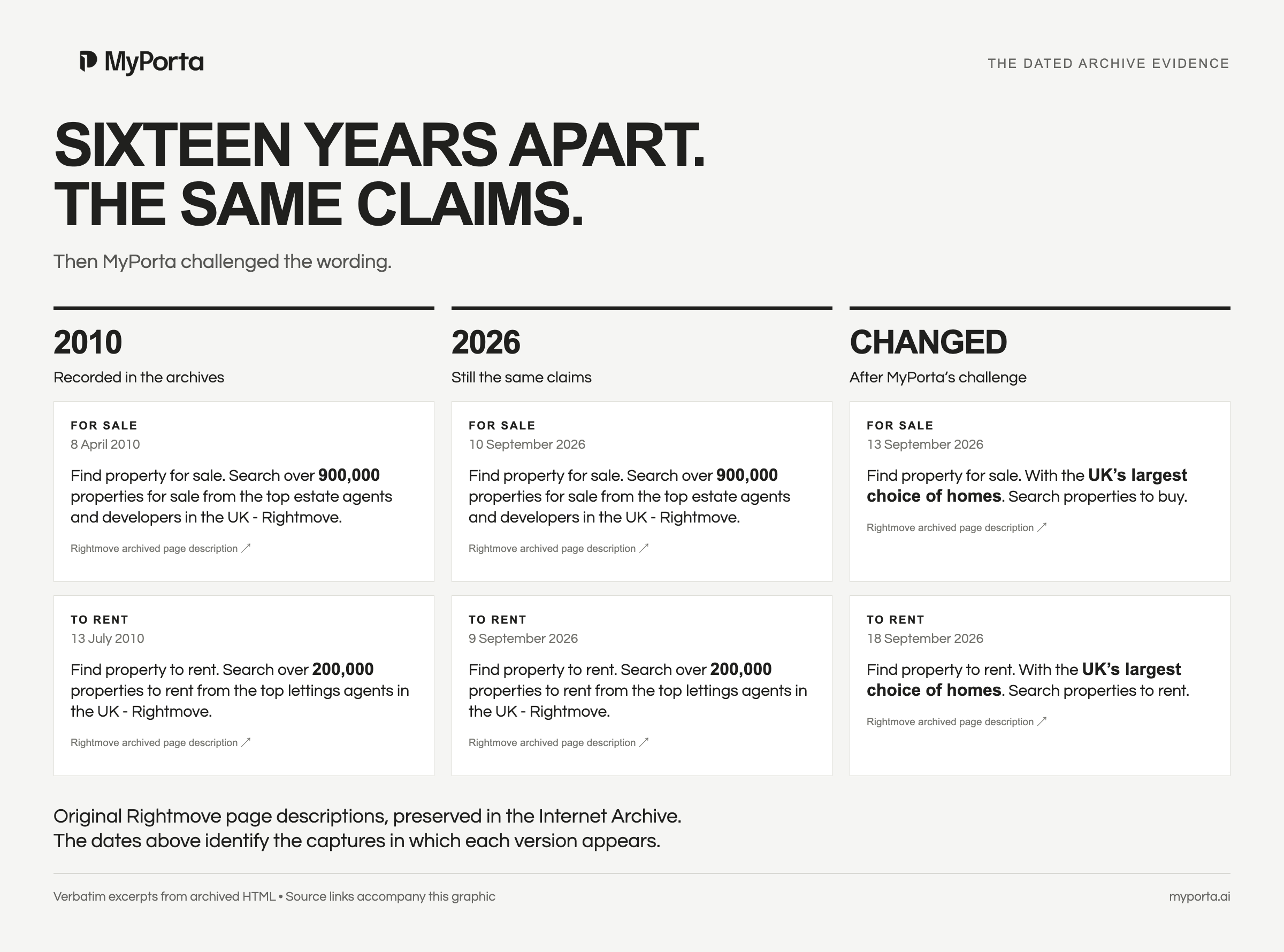
But this wasn't the first time that Rightmove had made this claim - in fact, the first time it appears on Internet Archive is in April 2010.
16 years ago.
And it's been there pretty much ever since.
16 entire years where Rightmove has been claiming, without ever showing evidence, to have perhaps a significant amount more - up to, beyond, 40% more? - properties than they really did list.
That claim has to have made more consumers come to their site, doesn't it? Otherwise why put that number up in the first place?
The appropriate historical context records that Spring 2010 was when Zoopla was really starting to build a head of steam, a couple of years into its growth. Disclosure - I was Sales Director there at this time but this isn't a personal thing: this is a an industry thing, a lament to a thriving market that might have been.
Because we're seeing this exact same scenario play out in another sphere right now - of an organisation determined to win at all costs, not being straight with the wider public, and what that costs rule-abiding competitors and ordinary consumers.
In that same Spring 16 years ago, at the end of the 2009/2010 football season, Manchester City was setting its sights firmly on dominating its own industry.
According to the Premier League, during those intervening 16 years - a period where it appears Rightmove has maintained the exact same unsubstantiated claim to over 1.1m properties being on its site - City deployed nearly £1Bn of additional funds than it was allowed to do, via false sponsorship deals and secondary contracts with some players and staff, that allowed it to break into the elite of teams where it had rarely been - and to then break record after record for trophies, led by its outstanding manager Pep Guardiola. (These guilty verdicts on 114 of 115 charges are currently being appealed by Man City.)
From Spurs to Stoke, fans, players and managers from a bygone era are finding themselves wondering what might have been. For fans it's wider club recognition, better facilities, steps towards even greater club glory. For players, individual medals, stolen victory parades, higher salaries. And managers? Proof of strategic dominance, bigger club interest, perhaps a statue or two outside grounds.
And what could have been in our industry across those 16 years, had consumers not been told every time they searched on Google for 'property to buy' or 'property to rent' in the UK, that Rightmove had '1.1m properties'?
Imagine consumers understanding, earlier and more clearly, that they needed to look beyond Rightmove to see what else was out there. Zoopla gets another visit. OnTheMarket gets a proper look-in. An agent unwilling to pay RM doesn’t have to spend the first ten minutes of every market appraisal explaining why people will still see the vendor's property if they list with them.
Meanwhile, Rightmove’s reported average monthly per-branch charge rose from £379 in 2010 to £1,726 in the first half of 2026 - approximately 355%. An estimated £2.3Bn was taken from these funds and shipped to RM shareholders in dividends and share buybacks during that period too - with Directors extremely well-remunerated for doing so.
Perhaps a sizeable chunk of this would have been kept by agents - and enabled them to grow instead of one single, remorseless entity?
Because business owners know what that breathing space means. It’s the difference between making a sensible decision and making a desperate one. Between sleeping properly and doing payroll arithmetic at three in the morning.
There are plenty of reasons why agencies struggle. But it is reasonable to ask how many businesses might have been stronger had competition been able to put more pressure on most agents' largest marketing supplier.
Removing an advertising claim in September 2026 changes what consumers see next. It cannot send them back to the homes, services and businesses they might have considered five, ten, fifteen years before.
The last 16 years are beyond your control. Your next marketing decision isn’t. If you haven't already, stop voluntarily mentioning Rightmove as a marketing channel - sure, if you're asked, but it's increasingly irrelevant in the AI world as it doesn't have all the properties on it anyway (as we have seen). Plus, it corrupts the search results, by putting pay-to-win 'Featured Properties' at the top, instead of those the customer genuinely wants to see.
As more people use AI to search, they're going to hate having to plough through these results that do nothing for them, only benefitting this very old portal. And they'll start to look elsewhere.
We can't bring the past back. The legacies of 2010's Rightmove and Manchester City are becoming settled. The rest of the 2020's and beyond are up for grabs.
Will your own legacy - and that of your business - be one that makes the most of moments like these?