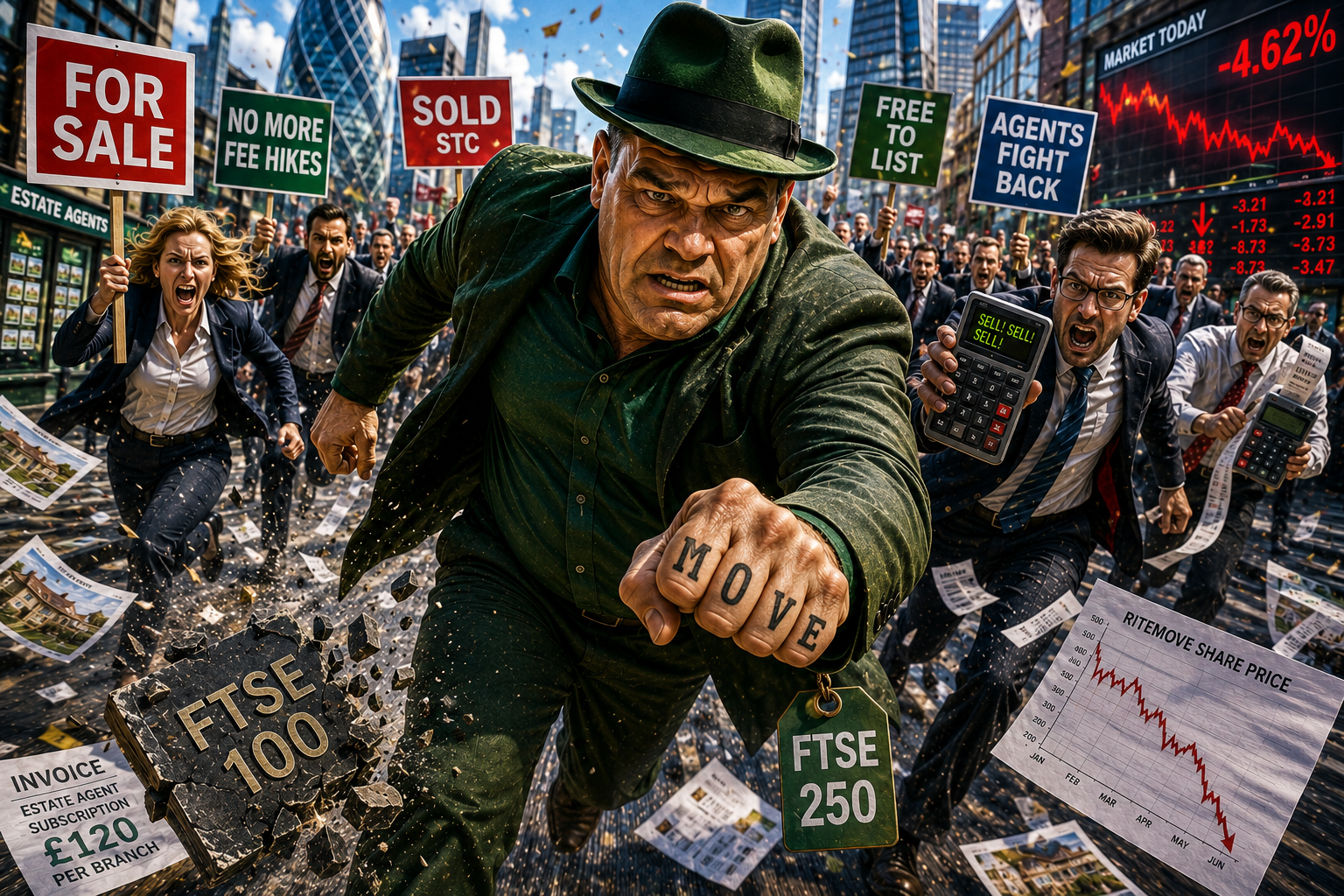
Three months ago, it took a pharmaceutical profit warning, a presidential bombing raid and the biggest oil spike in history to keep Rightmove in the FTSE100. This week, FTSE Russell confirmed what that unlikely trinity could only postpone: the UK's largest property portal is going down. From Monday 22nd June, Rightmove will be a FTSE250 company.
There was no rescue this time. There wasn't even a near miss.
Back in March, Johan Svanstrom's eleventh-hour £90m share buyback – announced alongside full-year results and an enhanced dividend – bought his stock a 4.3% bounce and a puncher's chance. It needed Hikma Pharmaceuticals to collapse on a Thursday and Iran's retaliation to torch easyJet's share price on the Monday and Tuesday, but it worked. Rightmove stayed up by the skin of someone else's teeth.
The obvious question, as the June annual review approached, was whether Svanstrom would reach for the same lever again. And in a sense, he did – the buyback machine was still running right up to the cut-off date of Tuesday 2nd June, with purchases logged on the 1st, the 2nd and even the 4th, after the die was already cast.
But look closer and the story is rather different. This wasn't a fresh injection of cash – it was the same £90m programme from February, still grinding through its allotment. By the AGM trading update on 7th May, only £44m of it had been spent. And far from accelerating into the review, the daily purchases actually slowed: roughly 260,000 shares a day through May dwindled to around 154,000 a day in the first week of June. If February's buyback was a haymaker thrown at the bell, June's was a man waving weakly at the referee as he slid down the ropes.
Perhaps that's because everyone at RM's Soho Square HQ could read the table. The FTSE's rules give incumbents a buffer – you're only automatically relegated if you fall to 111th place or below by market capitalisation, while a challenger is automatically promoted on reaching 90th or above. Sit between those lines and you're normally safe. In February, Rightmove was hovering right on the trapdoor, close enough for a buyback bounce and two collapsing rivals to matter. By the June cut-off, it sat at roughly £3.1Bn – around 117th. Not on the trapdoor; through it, down the stairs, and into the car park.
This time around, Rightmove was the only automatic relegation. The two other fallers, Mondi and Berkeley Group, were both inside the safety zone – but with three challengers (Aberdeen Group, Computacenter and Investec) storming past the 90th-place promotion line, and the index obliged to hold exactly 100 names, the two lowest-ranked survivors were squeezed out to make room. They were shoved; Rightmove fell.
What changed between March and June?
Estate agents fighting back.
In April, a £1.5Bn claim was filed against Rightmove at the Competition Appeal Tribunal, knocking another 10%+ off the share price in a day. It turns out that when your business model is charging a captive industry whatever you like, eventually somebody asks a tribunal whether that's entirely legal. No buyback outruns that arithmetic. At £1m a day, Svanstrom's programme was trying to bail out a supertanker with a champagne bucket.
And the ironies, as ever in this saga, write themselves. easyJet – the airline relegated in Rightmove's place in March, collateral damage of a war it had nothing to do with – has spent its first months in the FTSE250 being romanced. A "highly opportunistic" takeover approach from US investor Castlelake sent its shares climbing in June, the kind of attention that tends to find good businesses at unfairly depressed prices. Rightmove now arrives in the same division to keep it company, minus the suitors and minus the £90m. The unluckiest company of the spring got a bid premium; the luckiest CEO in London discovered that luck is not a strategy. Stelios will allow himself a smile.
There's a sharper point under the schadenfreude, though. Since February, Rightmove has spent the thick end of £90m – cash generated from estate agents' subscriptions, alongside a £120-per-branch price rise – buying its own shares, and its reward is relegation anyway. That money is gone. It didn't build the AI tools that are supposed to justify the 2030 growth story; it didn't reduce a single agent's bill; it briefly flattered a share price that fell regardless. The City got its bribe and banked it.
The FTSE250 is not oblivion – easyJet has bounced between the divisions three times and lived to tell the tale. Rightmove remains an (alleged) monopoly with 250-odd million pounds of operating profit and four petabytes of data. But index relegation has real consequences: tracker funds must sell, some institutions can't hold mid-caps, and a takeover approach – REA Group's 2024 tilt is not forgotten and the portal-disrupting AI wolves are circling – gets cheaper by the week.
In March, Johan Svanstrom celebrated his third anniversary at the helm with bubbles and a reprieve delivered by American bombs. This weekend, there is no Hikma, no global surprises, no Trump. Just a results table that no longer has Rightmove's name in the top division – and a CEO who has discovered that you can rent luck but, no matter how high you increase your customers' fees, you can't buy it back.
Join me on the Rightmove Resistance Tour 3 - The Tipping Point, to learn more about using AI in your business to win market share, cut costs - particularly portal costs! - and increase revenue. Go to www.modelprop.ai/summer26