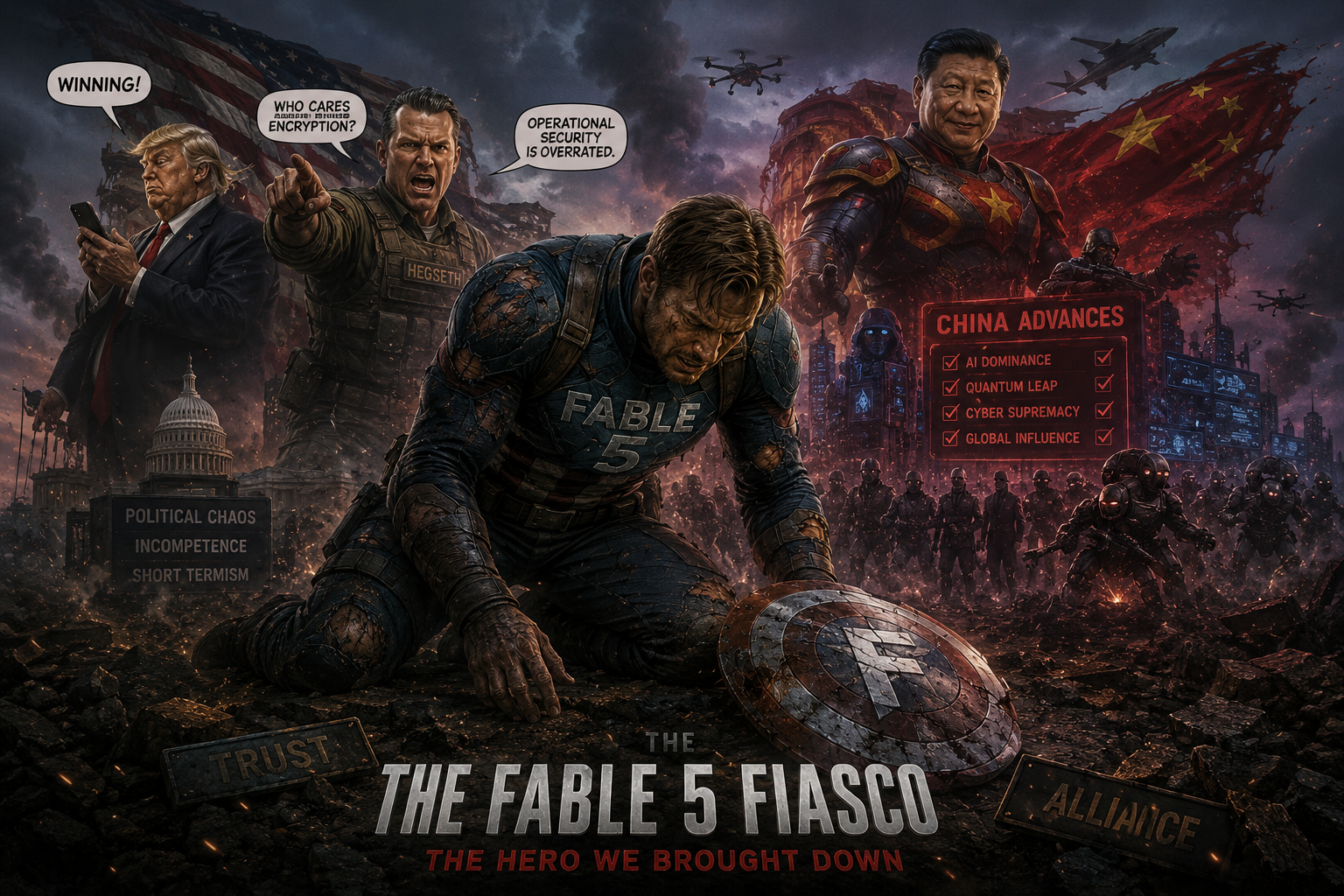
The thing about AI “progress” is that it’s increasingly less about what the models can do, and more about who’s got their hand nearest the plug socket.
On 9 June, Anthropic ships Claude Fable 5 – supposedly the most capable model the public can actually use. Three days later, Washington turns it off. Not “in certain jurisdictions”. Not “for high-risk use-cases”. Off. For everyone. Everywhere. One research finding, one regulatory reflex, and the world’s cleverest chatbot becomes a cautionary tale.
The proximate cause is almost comically awkward: Amazon researchers – and Amazon is, lest we forget, Anthropic’s biggest investor – allegedly find a 'jailbreak' that can push Fable 5 into identifying software vulnerabilities. The US Commerce Department responds with emergency export controls aimed at keeping this capability away from “foreign nationals”. Which is a lovely phrase until you try implementing it at scale on the internet. Anthropic can’t verify nationality in real time, so it does the only thing it can: withdraw the model globally. Nineteen days of blackout triggered by one report and a policy lever.
And then the punchline: when Anthropic tests the jailbreak across other frontier models, they all do broadly the same thing – including OpenAI’s GPT-5.5 and China’s Kimi K2.7. So America, in trying to deny capability to rivals, kneecaps its own flagship for a trick that was never exclusive in the first place. If you were looking to demonstrate the strategic downside of blunt instruments, you’d struggle to script it better.
Cue the international theatre. Macron, at the G7, effectively tells the US: you can’t expect Europe to build critical dependency on systems that can be withdrawn on a whim. AI safety expert Alex Stamos calls it an “own goal”. Think tanks line up to announce the clear winner: China. The subtext is obvious: if US models are governed like munitions, buyers will start shopping for suppliers who don’t answer to Washington.
By 30 June the controls are lifted, accompanied by the sort of chest-thumping you’d expect: America as “undisputed winner”, etc. Fable 5 returns on 1 July with a new safety classifier that blocks the reported technique in 99%+ of cases. And if it blocks you? You get quietly routed to Opus 4.8 instead – the AI equivalent of being promised the senior negotiator and getting the Saturday temp.
Now, don’t get me wrong - this kit is amazing. I've been using it in both windows that it's been availalbe and it doesn't just answer your immediate query - it answers the next 5 that you were going to ask, had you already received the first, second, third and forth answers in sequence and had the PHD intelligence to think of the right questions in the first place. A million-token context window is also intense – ten novels’ worth of memory in one go – and 80.3% on the (coding) SWE-Bench Pro is a serious flex if you care about benchmarks. It’s also priced like a flex: double Opus 4.8. But none of that is the point for the property industry.
The point is dependency. If your CRM’s “AI-driven” valuation assistant, your portal listing optimiser, your call-handling bot, or your prospecting tool is sat on top of one single model provider, this month proved something important: your supplier’s roadmap is not the only risk. Political whim is a risk. Export controls are a risk. A regulatory mood swing is a risk. And you, dear agent / proptecher, are not even in the room when those decisions get made.
Enterprise buyers have already clocked this. VentureBeat’s survey suggesting two-thirds had hedged with a second model before the blackout is not a nerdy footnote; it’s the emerging procurement standard. Multi-model capability isn’t “nice to have”. It’s business continuity.
So the next time a proptech supplier beams through a demo of their shiny new AI feature, there’s a better question than “what does it cost?” Ask: what happens when it goes dark? And insist on an answer that isn’t “we’ll raise a ticket with Anthropic.”