Keir Starmer has finally done what every housing minister in living memory has flirted with and then quietly abandoned: he’s taken a proper swing at the English buying and selling process. Not another “let’s digitise the Land Registry by 2049” press release, but a package that - if it lands anything like advertised - will change the daily operating rhythm of every estate agency in the country.
And yes, the headlines have already done their thing. Mandatory packs. Earlier binding. Qualifications. A Code of Practice by Christmas. All very bold. All very “biggest overhaul in a generation”. The more useful question for agents and proptech firms is simpler: what’s actually going to break first when this hits the real world?
Because something will.
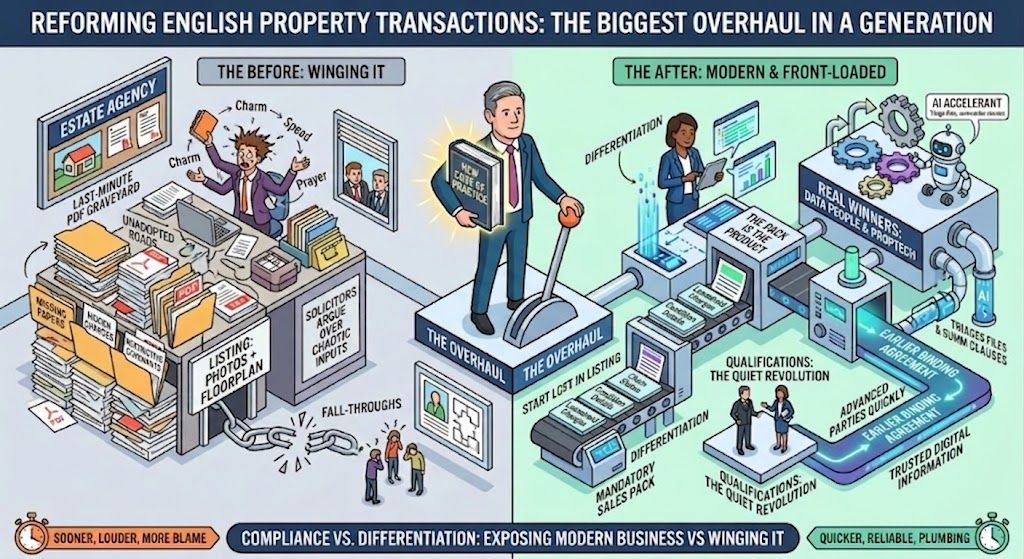
The pack is the product
The key change is not philosophical. It’s operational. Sales packs at the point of listing means the listing is no longer “photos + floorplan + a hopeful description + on we go”. The listing becomes a compliance artefact. Leasehold charges, condition details, chain status - upfront, standardised, and presumably in a format that can be checked, shared, and relied upon.
This is where the Government thinks it cuts fall-throughs. And it will, to a point. Most fall-throughs are not caused by flaky buyers waking up with cold feet (though there’s plenty of that). They’re caused by late-arriving reality: service charges that turn out to be bonkers, unadopted roads, missing certificates, restrictive covenants, a loft conversion that looked “fine” until a solicitor asked for paper.
So yes, packs help. But only if they’re trusted and not just another PDF graveyard compiled under pressure the night before the first viewing.
Binding earlier: good luck without plumbing
Earlier binding agreements sounds marvellous if you’ve ever watched a chain collapse because one party decided to “have a think” after six weeks. It also sounds like a policy written by someone who’s never tried to get two solicitors, a lender, a managing agent and a surveyor to align on the same facts inside a fortnight.
You cannot bind earlier unless the information arrives earlier. Which means the whole system becomes a race to front-load data, verification and identity. That’s not a cultural shift; it’s a technology and process shift. If agencies aren’t already using structured data capture, automated chasing, digital ID/AML, and decent integrations with conveyancers, they’re about to find themselves doing “earlier binding” with the same chaotic inputs - just sooner, louder, and with more blame flying about.
Qualifications: the quiet revolution
The qualifications consultation from 2027 is being framed as professionalism - and it is - but it’s also a signal to consumers that estate agency is going to stop being treated as a casual trade. The bigger impact isn’t who gets pushed out. It’s who leans in.
If you’re a strong independent who already runs a disciplined process, this is a gift. Regulation has a funny way of flattening lazy competitors. The agents who’ve built their business on charm, speed, and a prayer will discover that charm doesn’t compile a leasehold pack.
The real winners: data people
Proptech should be grinning, but only the bits of proptech that understand what Government is really asking for: trusted digital property information. Not “a dashboard”. The plumbing. The infrastructure. The boring stuff that makes transactions quicker because everyone stops asking the same question five times.
And AI? It’s not the headline, but it’s the accelerant. AI can triage pack completeness, spot inconsistencies, chase missing documents, summarise lease clauses in plain English for buyers, and flag risks before they become deal-killers. Used properly, it cuts time, not corners.
Are you ready, though?
That’s the only question that matters. Not whether the Government will deliver every line on time (they won’t). Not whether the industry moans (it will). But whether your agency has the muscle memory - systems, habits, templates, partners - to operate in a world where “getting it on a portal” is the end of phase one, not the beginning of the whole job.
Those who treat this as compliance will hate it. Those who treat it as differentiation will quietly take market share while everyone else is still arguing about whether it’s fair.
The reforms won’t fix everything. But they will expose who’s been running a modern business all along - and who’s been winging it on adrenaline since 2009.