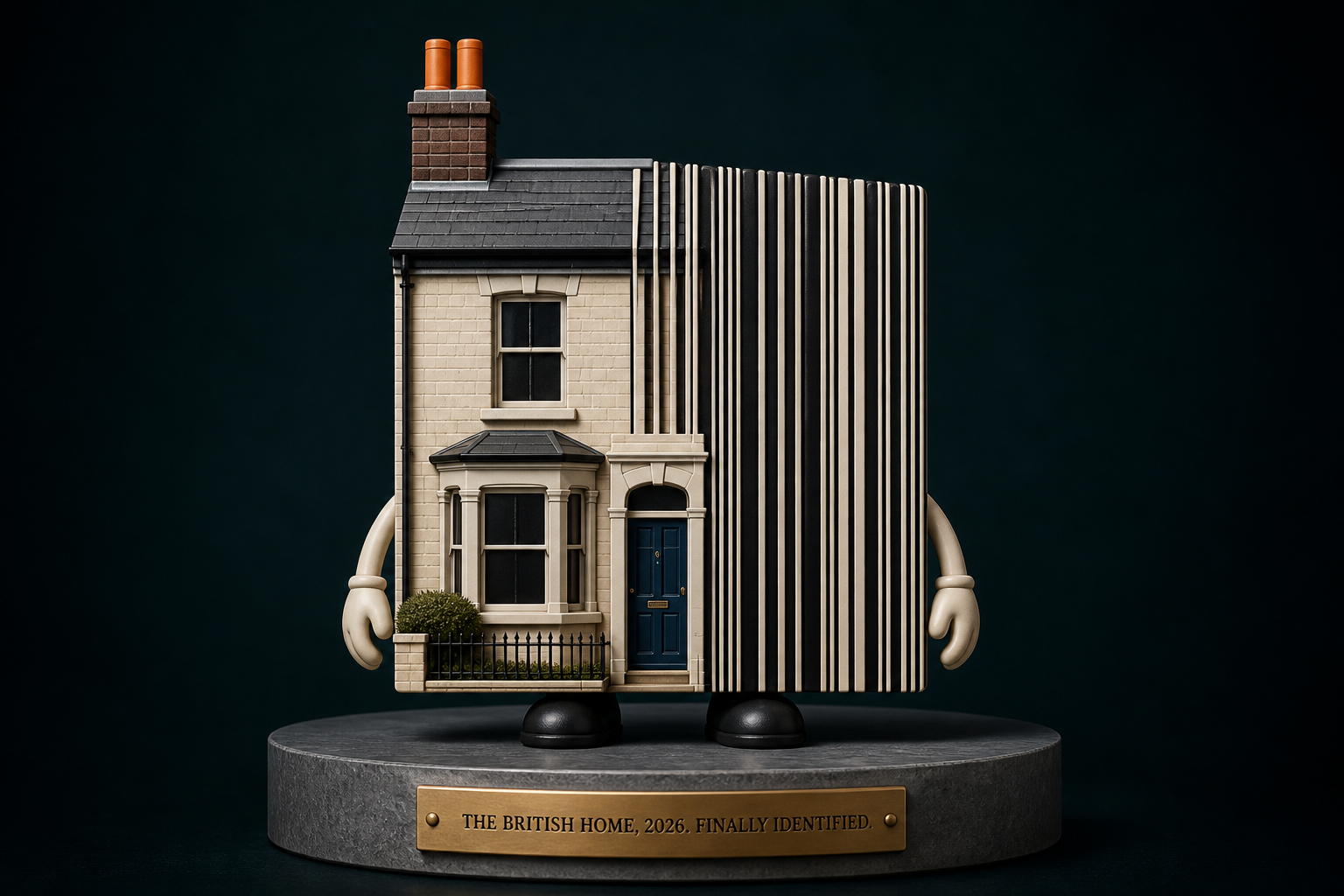
Back in 2008, when I joined Zoopla, Founder & CEO Alex Chesterman had a wonderfully unfussy way of describing a very unfussy problem: every property should have a barcode.
Not a postcode. Not an address that gets typed six different ways into six different systems by six different people. A proper, permanent, unique identity that computers can rely on, even when humans can’t be bothered to agree whether it’s “Flat 2” or “Second Floor Flat”.
It has taken an age, but on this week HM Land Registry made a move that actually matters. From now on, its monthly Price Paid Data will be published with a lookup table that includes the property’s Unique Property Reference Number (UPRN), alongside an INSPIRE (Infrastructure for Spatial Information in Europe) ID for the relevant land parcel.
It sounds like the sort of thing only a data wonk could love (and, as a data wonk you know that I do). In reality, it’s the nearest thing we’ve had to that barcode idea becoming real at scale - and that is going to matter for your business too.
We’ve built a frankly daft amount of UK property tech on postcodes. Yes, they’re useful. Yes, they get the post delivered. But that’s the point: they were designed for postal delivery routes, not as a definitive digital identity for a home.
One postcode can cover a whole street, half a street, a tower block, a business park, or a cluster of houses that made sense to a postie’s round years ago. That’s not an identifier; it’s a convenience.
And no, the answer isn’t to swap it for a novelty. what3words is clever and can pinpoint a location precisely, but a property isn’t simply a dot on a map. A home has boundaries, title, planning context, school catchment implications, flood exposure, transport links, EPC history, a sale price trail, and all the physical context that makes “near the park” mean something.
The job isn’t to replace addresses. It’s to give every property one permanent key, then let everything else attach to it. That is what a UPRN is for.
Price Paid Data is already bedrock: it’s the dataset everyone leans on for comparable evidence, indices, AVMs and market analysis across England and Wales. Adding UPRNs and an INSPIRE land-parcel reference makes matching sale price to the correct home far more dependable.
At first glance, it looks like housekeeping. Then you remember how much time and money the industry wastes reconciling messy address strings.
“Flat 2, 14 High Street” versus “2/14 High St”. Renamed or renumbered houses. New-builds where the marketing address and postal address don’t quite agree. Conversions “behind the pub” that everyone understands until a database tries to.
Humans muddle through. Systems duplicate, mis-match, or shrug and leave holes. A UPRN gives agents, portals, lenders, surveyors, local authorities and proptech firms a shared reference point, even when the written address varies. Land Registry is explicitly signalling that the lookup table is there to help connect sale-price data with mapping and wider datasets.
Not glamorous, perhaps, but neither was the barcode until it made modern retail possible.
This is where estate agency should pay attention. A persistent identity allows demonstrable facts to follow a home across time, rather than being rebuilt from scratch every time it’s listed.
Historic sale prices and title context. Distances and routes to stations, schools, parks, town centres and rivers. Flood, conservation, planning and environmental constraints. Boundaries, orientation, plot context and mapping links. EPC information and the practical drivers of running costs.
Those are facts, and they ought to travel with the property.
Then there’s the other layer: the human, local-expert layer. The skylight that transforms a kitchen. The Victorian terrace with incredible views. The “feel” that makes buyers decide in the hallway. Those are not the same kind of truth as “0.4 miles to the station”, but they still deserve to be attached to the right home, consistently, over time.
A proper property record can hold both - hard evidence and human judgement - provided we stop mixing them up.
For years, getting a coherent picture of a home has meant paying your way through a chain of data firms, each with their own matching logic, coverage gaps, and commercial terms. There will always be a place for organisations that clean, enrich and interpret data.
But the industry is healthier when the underlying identity is public, stable and shared. If every system starts with the same barcode, competition moves up the stack: who tells the clearest story, who helps consumers make better decisions, who gives agents the sharpest tools.
Not who has the most impenetrable address-matching table locked in a cupboard.
This isn’t a finished “property graph”. The UPRN and INSPIRE lookup tables apply to Price Paid Data published from 28 August 2026 onwards. This is not a magic wand that backfills every historical monthly dataset overnight. And a barcode won’t rescue a weak valuation or make a lazy listing persuasive.
But it’s the right direction of travel.
Alex had it right in 2008: every property needs a barcode. Now the industry needs to stop treating UPRNs as just another dull column in a spreadsheet and start treating them as the foundation for a properly connected property record.
Because once we all agree which property we’re talking about, we can finally get on with truly understanding it - and then finding the perfect person to live in it.