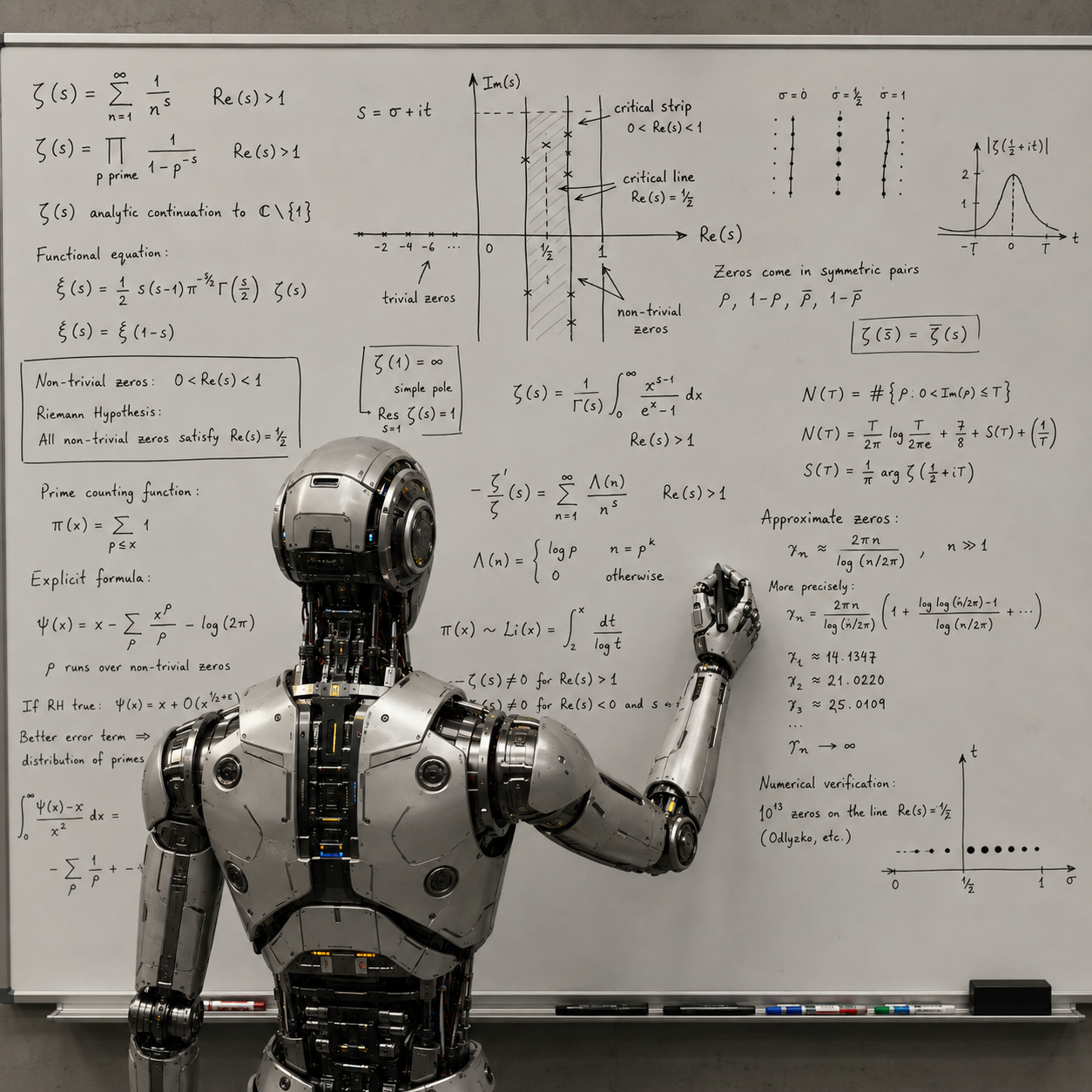
Anthropic has announced that an unreleased AI model has made significant headway on the Riemann hypothesis, a puzzle that’s baffled mathematicians for over 150 years. While the $1 million prize for a full proof remains unclaimed, this AI-driven progress is causing quite the stir in the mathematical community.
In an impressive feat, the model, guided by a non-mathematician, tested 650 ideas over a day and a half, using 60 subagents and a whopping 31 million output tokens. Two subagents hit the jackpot with key mathematical insights, while others contributed and validated ideas. The findings were confirmed by Anthropic's mathematicians and formalised using the Lean proof assistant.
This isn’t the first time AI has dazzled the math world. Earlier this year, AI models solved several Erdos problems and even disproved the Jacobian conjecture. OpenAI’s Astra model also delivered 10 major results, proving that AI is no slouch when it comes to number crunching.
Yet, this AI prowess is sparking debate. Some mathematicians worry that AI might overshadow the human touch in mathematical discovery. A public declaration in June voiced concerns about AI undermining the tradition of attributing proofs to individual mathematicians.
However, Fields Medal winner Timothy Gowers offers a fresh perspective, suggesting that AI might enrich the field in unexpected ways. He likens it to the fact that stars aren’t named after astronomers, hinting that perhaps the future of mathematics could be just as bright and collaborative.
As AI continues to push boundaries, the math world watches with a mix of excitement and caution. Who knows what other mysteries these digital brains might unravel next?
Want to hear more? Join Mal & Matt on the Property AI Report Podcast each week!
Access from your preferred podcast provider by clicking here
Made with TRUST_AI - see the Charter: https://www.modelprop.co.uk/trust-ai