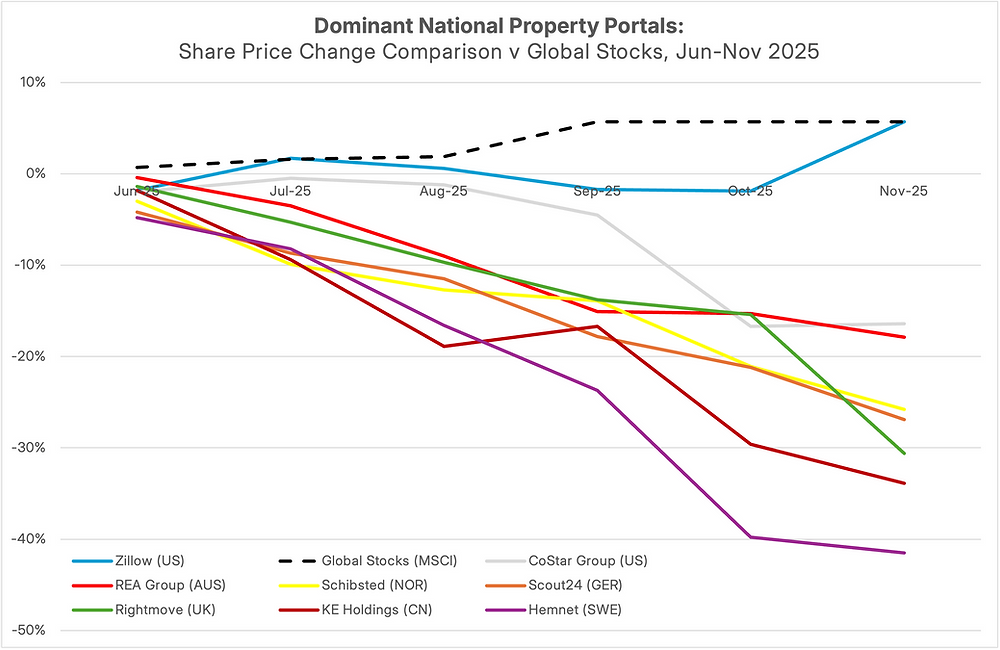
Take a look at this chart.
Now really look at it.
This isn't a market correction. It isn’t a dip caused by interest rates or a temporary housing supply crunch. What you are seeing in that sea of red ink - with (Sweden's) Hemnet down 41%, Rightmove down 30%, and (Australia's) REA Group shedding 20%, all in 6 months - is the start of an extinction event.
These are all the dominant portals in their geographical locations (aside from CoStar which wants to be that in the US, UK and Australia). With only one exception - Zillow in the US, which embraced AI early on - every one of them is haemorrhaging shareholder value.
For two decades, the dominant property portals have operated as extractive gatekeepers. They corralled homemovers, locked the gates and then held their eyeballs to ransom. If you wanted access to the buyers, you paid the price. These portals sat in the middle, fat and happy, gouging evermore fees with their monopoly on attention.
But as we hit the close of 2025, that business model isn't just under threat. It's evaporating before our eyes.
The sharp divergence we are seeing - where the traditional giants are bleeding out while AI-native strategies adapt - is driven by one thing: Agentic AI.
Portals are marketplaces. For the dominant ones to continue their growth, they need to monopolise two things: supply and demand. Thanks to AI, they are losing their grip on both.
Let’s be honest: agents and brokers despise most portals.
For years, these platforms have leveraged their monopoly to rinse every last pound, dollar, euro and krona from their clients. They forced agents to pay ever-rising subscriptions for "visibility" - the agent giving up their (expensively-assembled) listing content for free in the process.
Enter Agentic AI. This is AI that you give a purpose to; it has 'agency' (hence 'agentic') to find information, use online tools and act on what it discovers.
In 2026, if a property is listed on an estate agent's own website, an Agentic AI can find it. It doesn't need an "Optimiser" subscription to see it. The visibility that portals used to sell for a premium will be free.
In the coming 18 months, agents will discover that they don't need to subscribe for bulk property listings anymore. Why pay a portal to be a gatekeeper when the gate has been torn down? The moment an agent realises their inventory is discoverable by ChatGPT, Gemini, or Claude without a middleman, the portal's invoice becomes a voluntary, negotiable tax - and I think that agents won't want to upload every single one of their properties in future at all.
On the consumer side, the portal experience is equally broken.
Portals make money by interrupting your journey. They force you to plough through unasked-for "Featured Properties", "Brand Ads" and "Premium Listings." They show you what they are paid to show you, not what you actually want to see.
Agentic AI skips this friction entirely. You can discover the property of your dreams just by chatting - and 37% of consumers (according to Lloyds Bank) are already starting to move to what I think of as "vibe searching."
They don't want to filter by 3-bed, 2-bath, within 5 miles. They want to ask an AI to find them a place in Pontefract that feels like a quiet sanctuary, has morning light in the kitchen and is within walking distance of a good coffee shop. Agentic AI executes that search instantly, scanning the entire web - including independent agent sites - ignoring the paid-for rankings that portals rely on for revenue.
The value proposition for the traditional, dominant portal was simple: Agents pay us to privilege their properties.
That proposition is dying. Agentic AI privileges relevance, not payment.
It democratises discovery and treats a listing on an independent broker’s site with the same - or more - weight as a listing on a major portal, provided the data is good.
The crash you see in the share prices of Rightmove, REA and Hemnet is the market finally pricing in this reality. These companies built their castles on a monopoly of information. But in an age of AI, information is liquid, free, and uncontrollable.
The gouging gatekeepers are going. The walls are coming down. And as the graph shows, the market is realising that, for many coming late to AI - particularly those that have spent decades rinsing agents for as much as they possibly can - there is no turning back.
<path fill-rule="evenodd" cli